Imagine leaving a shaded neighborhood, taking a short, electric shuttle trip to a nearby station, and then boarding a regional train to another emirate. You pass schools, healthcare centers, and parks surrounded by leafy, dappled, sheltered homes. Getting to regional destinations does not require the hassle of being behind the steering wheel. Here, mobility is more than movement – it is connection, convenience, and predictability.
As the UAE’s regional passenger rail network continues to shape transits between cities and communities, it presents an opportunity to rethink the land beside it. Instead of the railway corridors being physical urban edges of development, how can they grow to become the foundation for complete, mixed-use communities, where accessibility, climate-responsive design, and landscape are one integrated framework?
From Infrastructure Boundary to Urban Opportunity
Land beside major transport infrastructure is often seen as the back edge of urban development – a place to avoid instead of shape. In a Regional Rail City, this relationship changes. The railway becomes the community’s front door – a multimodal gateway connecting regional movement with mixed-use development, blue-green infrastructure, and people-centered public spaces.
Instead of organizing neighborhoods around roads alone, the station becomes the center of a connected first-and-last-mile network connecting electric shuttles, bicycles, e-bikes, and people walking along the local streets. A clear arrival sequence, from the station plaza, to the street-facing shops, cafes, and community spaces makes the railway an identifiable urban destination. Landscape buffers and building placement ensure operational noise remains carefully mitigated, creating a safe, gradual transition into the surrounding neighborhoods.
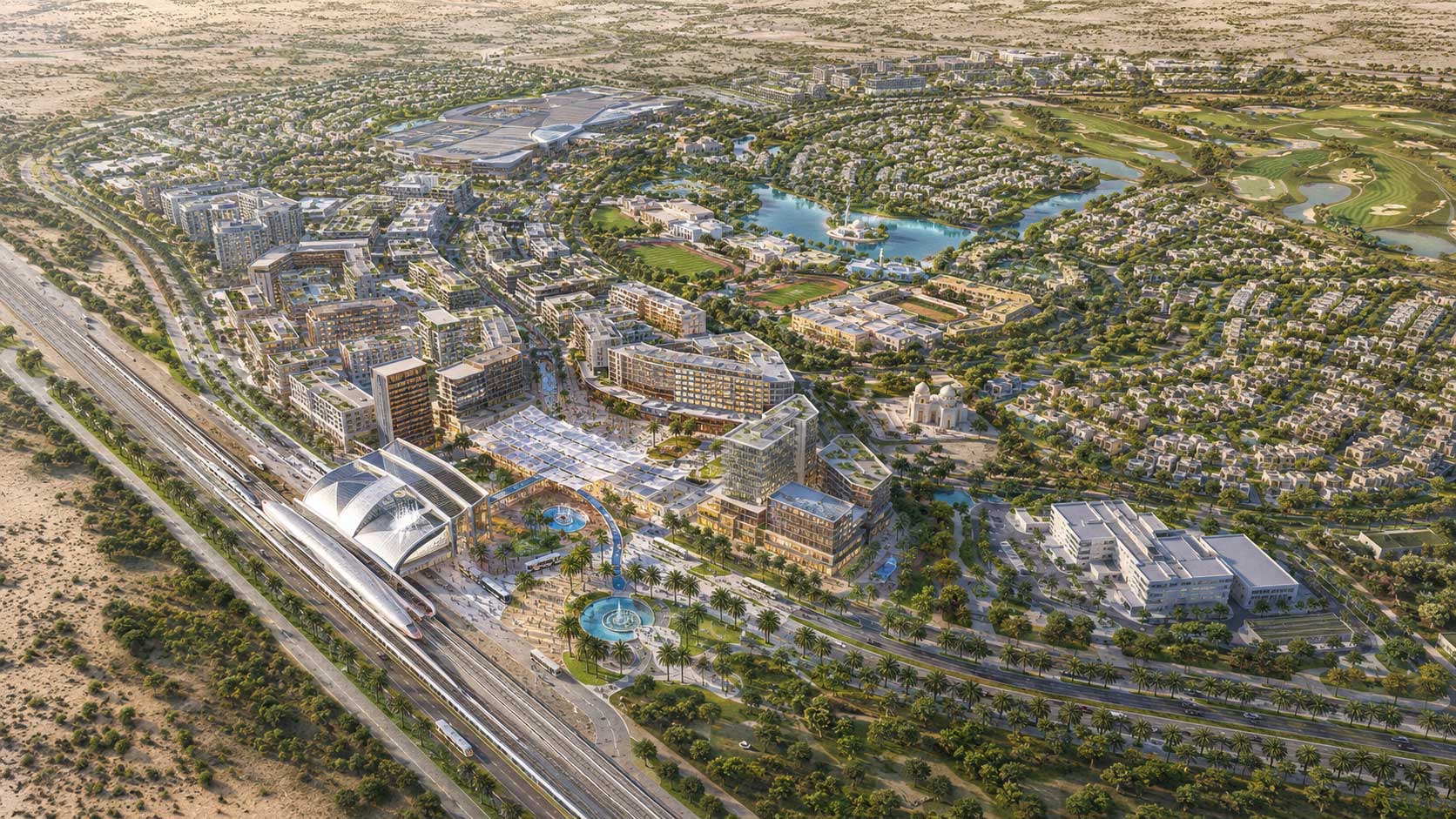
A UAE Framework for Complete Rail-Oriented Communities
The Regional Rail City goes beyond being just a station precinct, to creating a complete suburban community. Development remains carefully calibrated, with the highest intensity clustered around the station gateway. This opens to a vibrant town center, then lower density residential neighborhoods and recreational spaces further inward. Instead of dense apartment-only transit districts, this approach ensures a mix of townhouses, apartments, and villas within a network of connected neighborhoods.
Suburban growth also becomes vastly integrated. Other than residential subdivisions relying on distant destinations, regional attractions, employment, and everyday services co-exist within a polycentric network of centers. Schools, healthcare facilities, mosques, hotels, parks, sports and wellness centers, recreational landscapes, and regional malls complement the station gateway, town center, and neighborhood hubs. Every phase functions as a complete community from the beginning, with essential social infrastructure and mobility connections delivered alongside new homes rather than added later.
Designing Around Everyday Time
A well-planned community should go beyond shortening distances to returning time to the people. By bringing homes, workplaces, schools, healthcare, recreation, and others closer together, the Regional Rail City reduces unnecessary journeys and makes daily commutes more predictable. Locating frequent destinations within comfortable walking, cycling or, short electric shuttle journeys creates a more connected pattern of movement.
Nature and Mobility as Connected Systems
Landscapes shape how communities operate and remain resilient over time. Parks, lakes, shaded streets, and ecological corridors merge within public spaces to not only manage storm water but also reduce urban heat and strengthen biodiversity. Within the UAE, native and climate-adapted species such as Ghaf, Sidr, and Acacia not only reinforce local identity but also ensure hardiness in the arid climate. The result is environmental performance improving everyday experience and ensuring long-term urban quality.
The integrated approach extends to movement. Residents have a hierarchy of travel choices based on different needs. Regional rail supports longer-distance travel, complemented by local bus services, walking, cycling, electric community shuttles, and others. Instead of being isolated traffic corridors, streets are complete public spaces, with safe, shaded, clear routes connecting neighborhoods, parks, healthcare, and the station.
Together, landscape and mobility create a connected urban framework where both comfort and convenience guide movement. Walking beneath shaded tree canopies, cycling along green corridors or taking a short shuttle to the station become part of the same continuous experience, demonstrating a climate-responsive design.
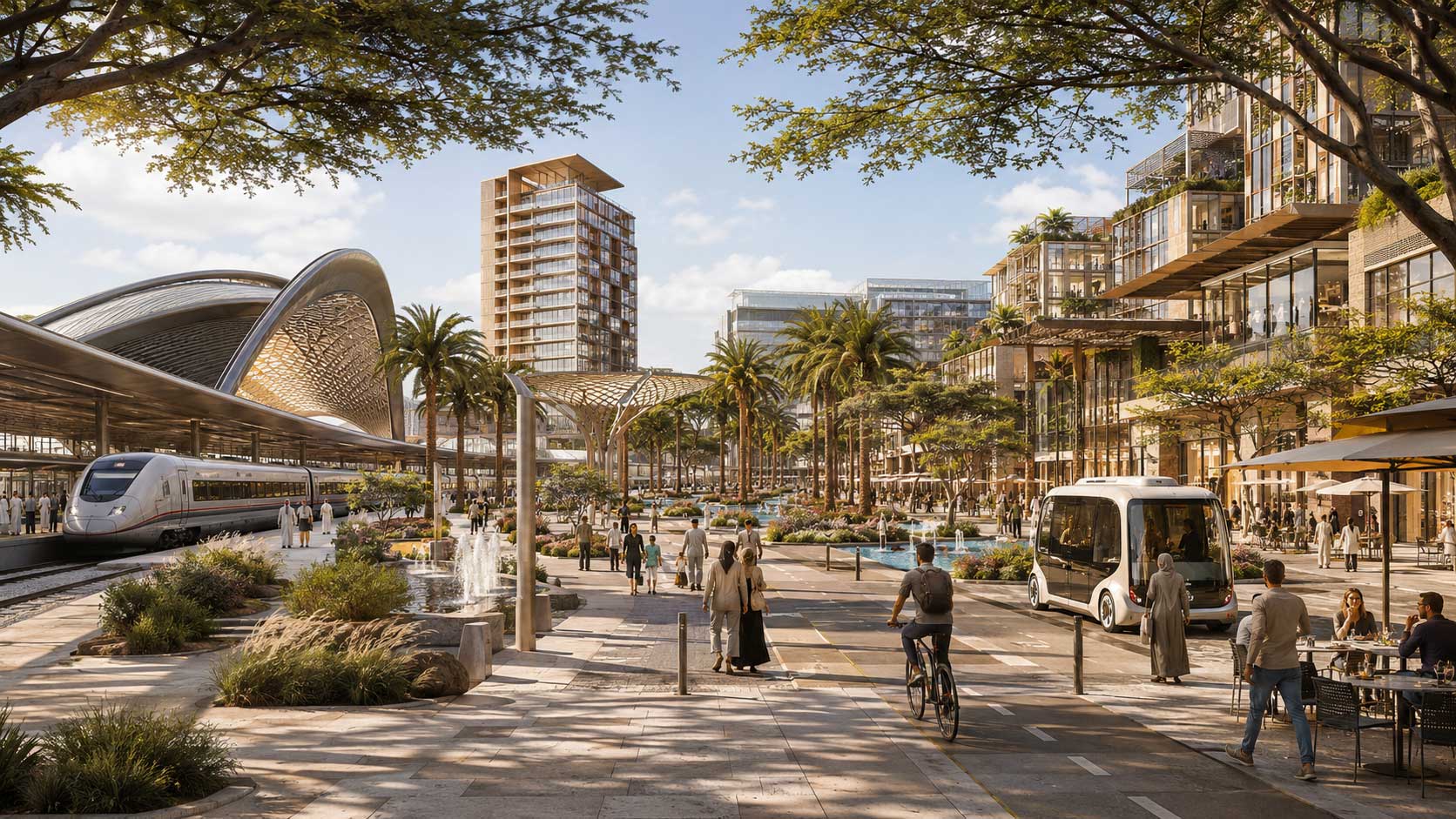
Designed for People
The success of a masterplan is ultimately dependent on how it supports the people who use it daily. The Regional Rail City is for families walking children to school, older adults accessing healthcare, commuters travelling to work, tourists visiting local destinations, and others. Safe working routes, shaded waiting areas, and active neighborhood centers encourage active, daily, activity without requiring an extra expense from these users. Buildings overlooking streets and parks and civic spaces further provide natural surveillance, reinforcing safety and a sense of community.
Integrated Design from Vision to Delivery
Creating the Regional Rail City requires integrated planning, where land use, transport, urban design, architecture, sustainability, and engineering work together. Decisions influence accessibility, environmental performance, infrastructure capacity, long-term resilience, and the daily experiences of residents.
At STUDIOI, this integration is critical from the beginning. Through coordination at the multidisciplinary level while engaging relevant authorities from the earliest stages, we ensure the masterplan grows as a coherent merged framework instead of independent technical solutions. The result is that that mobility, ecology, utilities, public spaces, and development work together from concept through delivery, creating communities that are not only practical to implement but also perform as complete urban environments.
As the UAE’s regional railway network expands, it presents an opportunity to think not only about how people move, but also about how communities grow. Design thinking should evolve towards an integrated urban framework where regional mobility, complete neighborhoods, ecological systems, and climate-responsive public spaces become one.
The railway should not define another back edge of urban development. It should become the beginning of a connected, resilient, and people-centered design.
Author: Marwan Alsheryani, Architect / Urban Planner
Related Articles
Inside STUDIOI: Lighting Design
Jelena Kadric, Head of Lighting (Group) at STUDIOI, leads a Sarajevo-based team…
Landscape Architecture: Mere Decoration or the Immune System of Our Cities?
Landscape architecture is no longer about aesthetics - it’s public health and…
Inside STUDIOI: Interior Design
Go inside STUDIOI's Interior Design department with Head of Interior Design…